

Agents are loops
Why I'm not doing anything that isn't a loop anymore

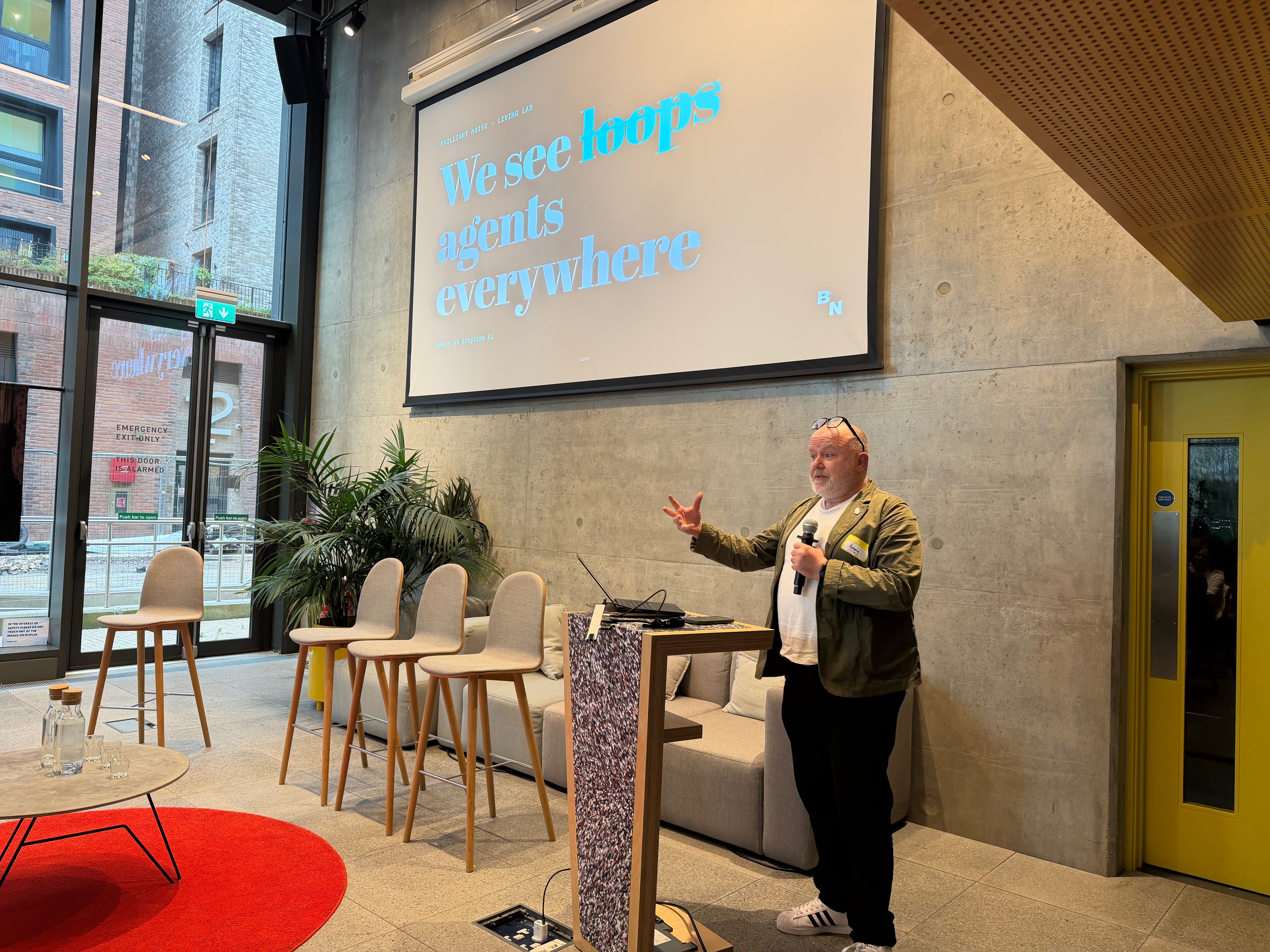
I was asked to talk about agents at Brighton AI last night, which is a brief that could mean almost anything to anyone. So I put one line on the opening slide – we see agents everywhere – and then crossed out “agents” and wrote “loops”.
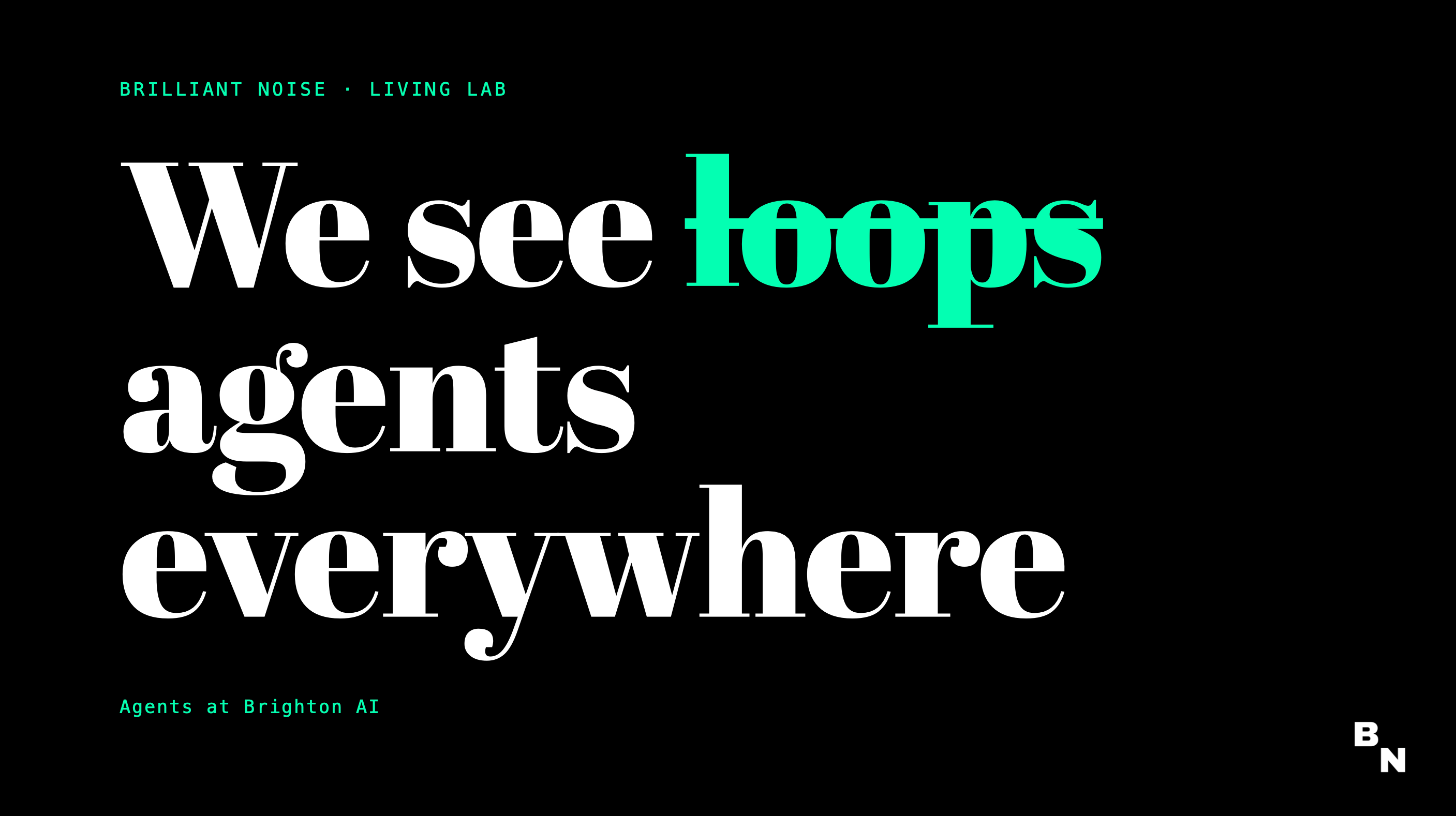
I’ve decided I’m not going to do anything that isn’t a loop any more. I’m quite cross about it, in a productive sort of way.
The ladder nobody hands you
Most people climb the same ladder with AI, whether or not anyone tells them it exists.
You start by prompting. You prompt, and you prompt, and you prompt, until prompting the same thing for the fortieth time becomes maddening. So you reach for the next rung – a custom GPT, a Gem, something you can point at your own context. You work with those for a while and then you think: I wish this one could talk to that one. I wish I could control the data going into it. And that wish, more or less inevitably, is an agent.
There’s a rung beyond that too, where agents start talking to each other and improving each other – systems of agents – but you don’t need to go there to get the benefit. Each level of literacy frustrates you into the next. The frustration is the signal. It’s telling you the work has outgrown the tool.
A year ago I’d have told you agents were hype. Everyone declared 2025 “the year of the agent” while most of us hadn’t touched one or felt one – we just had people trying to sell them to us. So we reserved judgement. We don’t any more. We now tell clients agents are everywhere, because once you know what to look for, they are.
Most of the barriers are in your head
We work with organisations of every size – from startups to Barilla and BMW – where teams are trying to get to grips with this. And the barriers almost never turn out to be technical. They’re about what’s in people’s heads: how they see the world, how they frame a problem, how they think. And, if you’ll forgive the phrase, how they think about thinking.
AI is a cognitive accelerator – it speeds up thinking. That is not an unalloyed good. Speeding up bad thinking just gets you to the wrong place faster. So the work matters less at the level of the models than at the level of noticing how you work, and deciding to change it.
I put a Richard Dawkins line on a slide for this, because he said it more bluntly than I could:
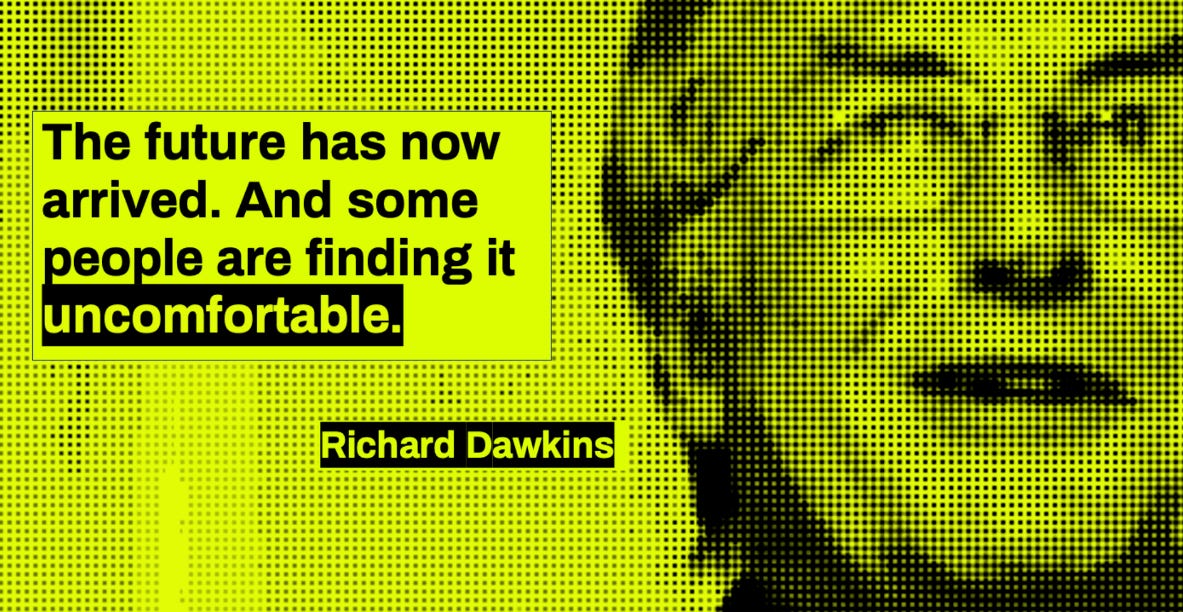
What I like is that it admits the discomfort rather than picking a fight about machine intelligence. After decades of being told at conferences that “the future is already here, it’s just unevenly distributed”, it’s oddly refreshing to hear someone simply say: yes, it’s here, and it’s a lot.
The trick is to stop worrying about the bits you can’t touch. You don’t get a vote on data centres in Colorado or which frontier model ships next. You do get a vote on the loop in front of you. Work your circle of control. That’s where all the value is anyway.
That itch is an opportunity
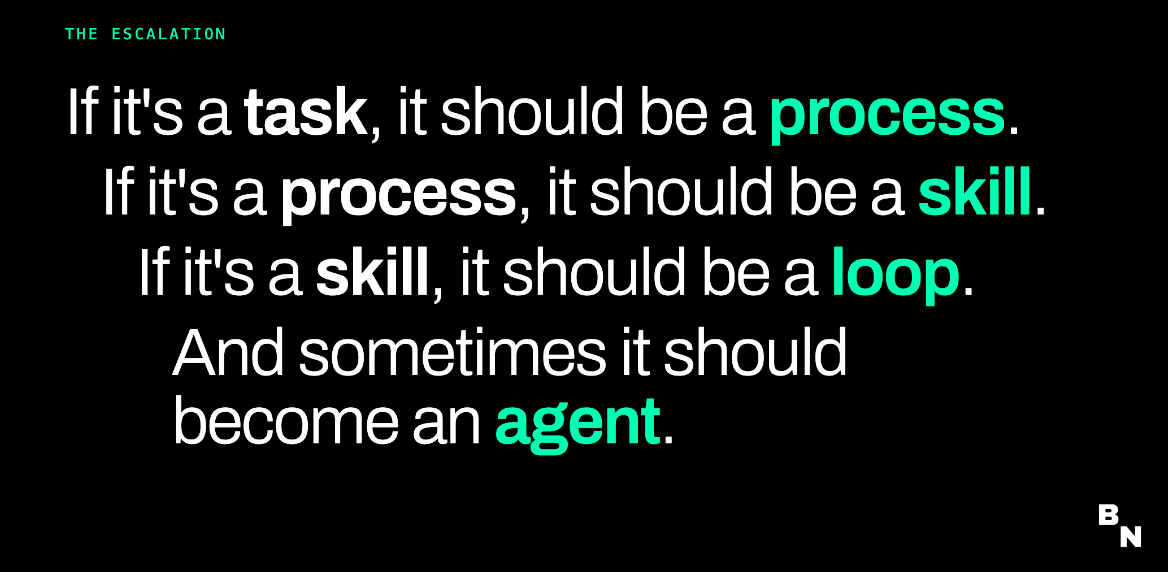
The method, such as it is: every time something annoys me, I treat the irritation as a flag. That thing that just wound me up is almost never a one-off task. It’s a process that nobody has written down yet. And if it’s a process, it can probably be a skill.
A skill, in the sense I mean it, is just a plain-language file that explains to an AI exactly how to do something. If you’ve prompted your way to a good result, you can now say to most AI tools: that was good – turn it into a skill. It writes the file. And those files travel: the same skill works in Claude, in ChatGPT, in Gemini. Once it’s a skill, it should become a loop – something that keeps getting better every time you run it rather than something you redo from scratch.
That chain was the slide I cared about most:
An example: our co-working space has a room-booking system with no API, no shortcuts, nothing I’m allowed to plug into. Just a fiddly drop-down I have to wrestle every single time. The other day when I was booking a meeting room I thought “why do I have to do this?”
So I opened Claude in Chrome (a browser extension that can take over the app), pointed it at the booking page told it “this is a room-booking system, figure it out”, and went away for fifteen minutes.
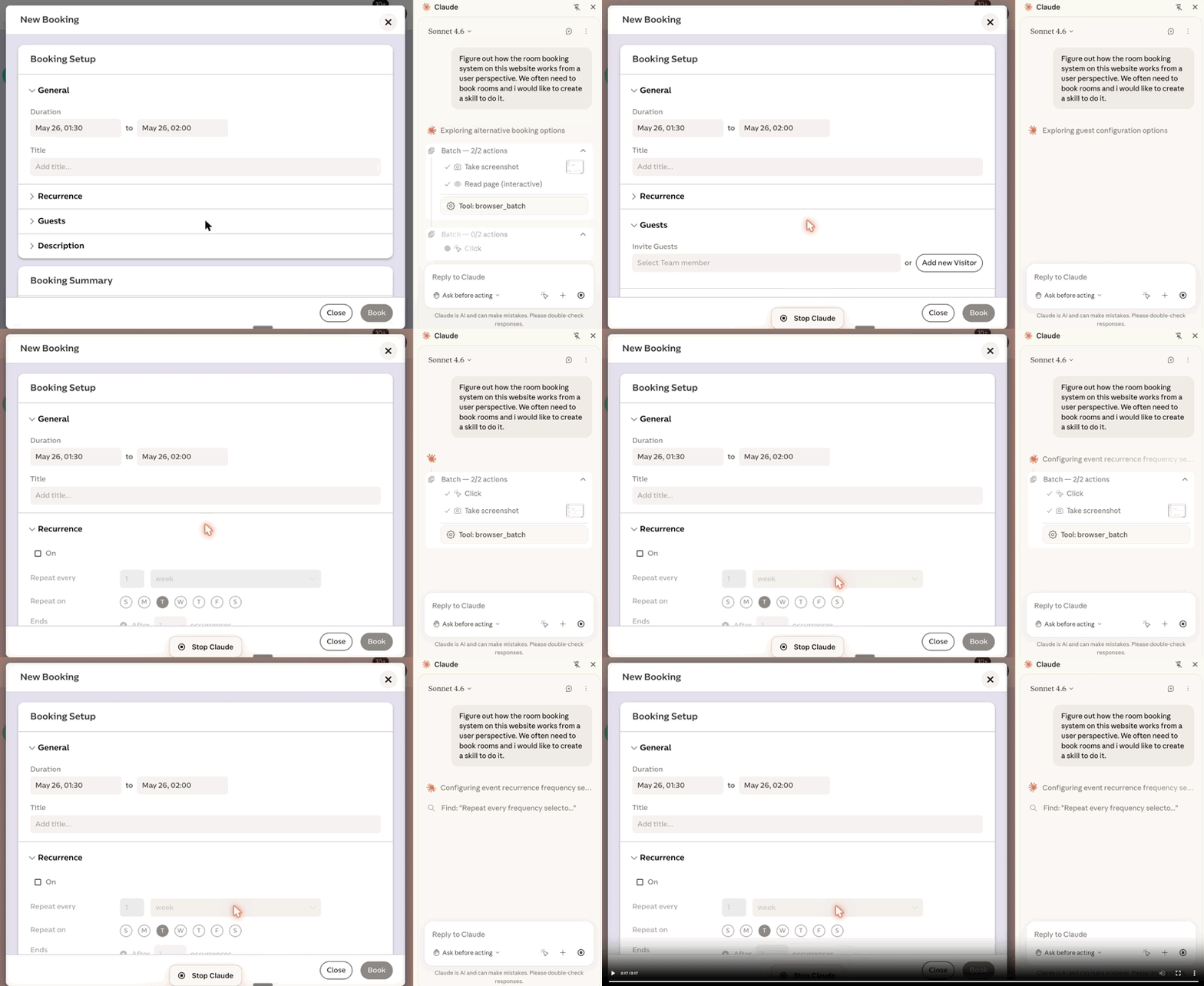
It clicked around, got a few things wrong, found options I didn’t know existed, and booked my room.
Then I prompted it “I never want to do that again – turn it into a Skill” (capitalised in case you haven’t heard of Skills in the AI context yet). Now my Claude Cowork morning assistant bot books rooms for me and I never have to look at that website again. Not fancy. But it’s making decisions on my behalf, which is the thing that turns a loop into an agent.
Agents are loops in bigger systems. Nothing more mystical than that.
Skills beat process
Brilliant Noise has been a living lab for working with AI for about three years: anyone can use any LLM or tool, we do show-and-tells every week, anyone can expense any subscription (one rule – cancel it immediately; if you miss it when it switches off, it was worth keeping).
We have been working through what each wave of generative AI innovation means to actually do daily work and run a business. What we’re currently creating is how we work with agents and Skills.
What’s surprised me most is what Skills do to processes. We’ve been going fifteen years and we have gigabytes of beautifully written process documents from every era of the company. Almost none of them ever fully became culture – habits, how we do things round here – because a written process is a kind of burden – it tells you what you should do, or should have done.
A Skill is the opposite. It says: here’s how to do this, want a hand? And because we can now share skills across the team and push them to everyone’s machine, you’re not handing someone a tool. You’re handing them a way of working. When someone new joins, “this is how we write a proposal, at the right price” stops being a PDF nobody reads and becomes something that just shows up in their AI, ready to help.
The pattern under all of it: the Helix
The one pattern we now try to apply to almost any job we call the Helix. It came from a simple insight about working with AI: the better organised your data and the clearer you are about what you actually want, the better the output.
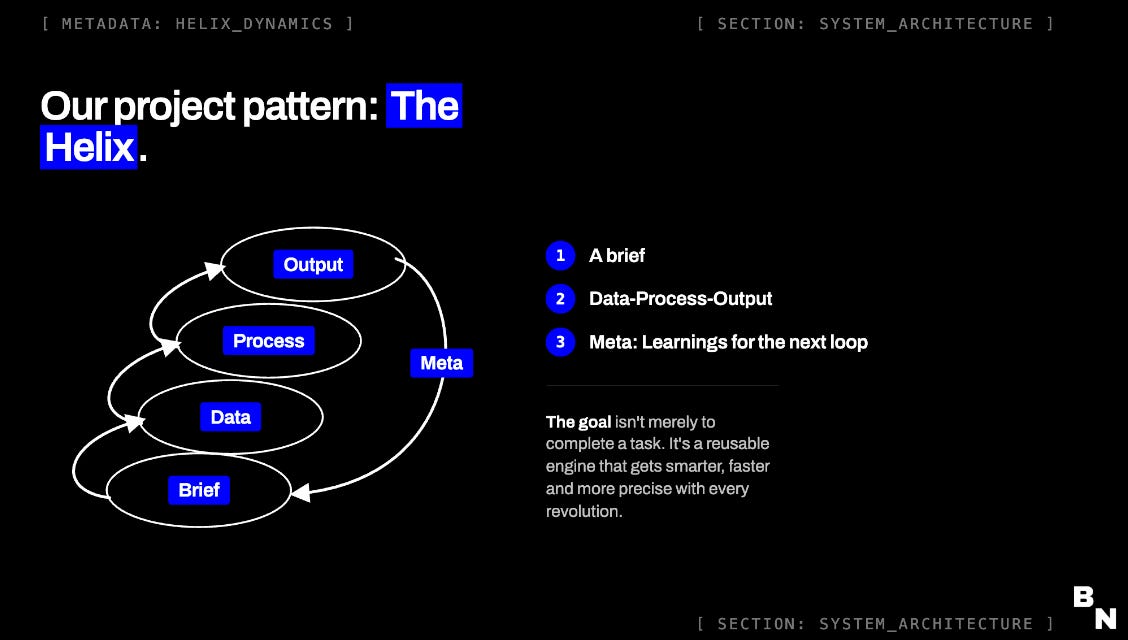
So we built it as five stages that loop: Brief, Data, Process, Output, Meta. The old instinct was to pour most of the effort into the output – open PowerPoint, start typing. With AI it works far better to put roughly 80% of your effort upstream, into the brief and the data and thinking through the process, and let the output fall out of that. We’ve turned the Helix into a skill, so starting a project automatically creates a folder for each stage. It quietly fixes a lot of human sloppiness on the way – not least forcing an actual brief, with actual defined outcomes, before anyone charges off.
The fifth stage is the one that makes it a loop. Meta is where you capture what you learned and feed it back in, so the next run is sharper. The goal was never just to finish the task – it’s a reusable engine that gets smarter, faster and more precise with every iteration.
The bonus is that your work is now organised around the project rather than scattered. Anyone who joins – human or agent – can read the folder and start helping immediately, instead of being handed a pile of stuff someone needs out the door by Thursday.
What I’d recommend this week
Pick the next thing that irritates you. Don’t fix it once. Ask whether it’s really a task or an undocumented process, get an AI to write it down as a skill, and turn it into something that improves every time you touch it. Then do it again.
Keep everything improving. Everything you’re not improving with AI is future drudgery you’ve agreed to keep doing by hand.
At the very least, you might end up with some actual briefs, which are always handy but so often completely missing from projects.
 | A guest post by
|